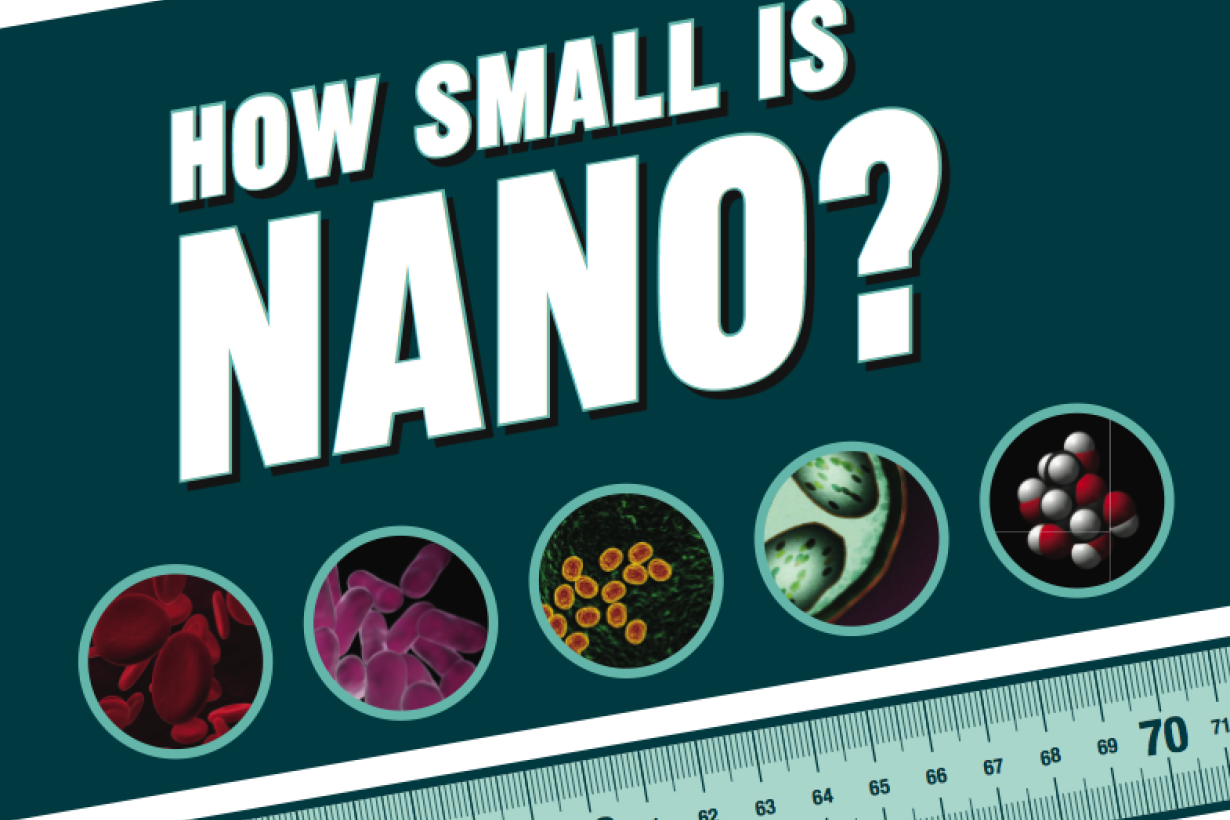
NanoBuzz
Powering the World's Cell Phones, One Marathon at a Time
![]()
Electricity from Viruses: Berkeley Lab scientists generate electricity using viruses.Courtesy Courtesy ksoScientists from the Berkeley Lab have developed a way to generate electricity from viruses! Their method is based on the piezoelectric properties of the virus, M13 bacteriophage. Piezoelectricity is the charge that accumulates in certain solids when a mechanical stress is applied to them (squeezing, pressing, pushing, tapping, etc.) The scientists realized that the M13 virus would be a great candidate for their research because it replicates extremely rapidly (no supply problems here), it’s harmless to humans (always a good thing), and it assembles itself into well-organized films (think chopsticks in a box). It was these films that they layered and sandwiched between gold-plated electrodes to create their nearly paper-thin generator. When this postage stamp-sized generator was tapped, it created enough electricity to flash a “1” on a liquid crystal screen.
The potential here is that someday we could put these super-thin generators in any number of places, and harness electricity by doing normal, everyday tasks like walking or closing doors. I propose putting them in the shoes of marathon runners and then have cell phone charging stations along the route. Nothing is more maddening than waiting all day in the rain to get an action shot of your runner, only to find that your battery has since died by the time your slow-poke reaches the finish line. There’s always next year.
Itty-bitty Art
![]()
World's smallest giraffe: Scanning electron microscopy (SEM) image depicting a baby giraffeCourtesy Image courtesy of the Materials Research Society Science as Art Competition and Shaahin Amini and Reza Abbaschian, University of California RiversideMaterials science is the study of the relationship between the structure of materials at the atomic or molecular scales and their properties at the macroscale. Materials scientists do a lot of monkeying around at super small scales, and the Materials Research Society (the organization that brings together materials scientists from academia, industry, and government) has given them a creative outlet. At each of their annual meetings, MRS includes a Science as Art competition, where any registered meeting attendee can enter an image they have created. The images are pretty amazing in their own right, but when you think about the methods, medium, and scale used to create them, it's truly mind-boggling! Here are some of the best entries from past meetings, and some video versions of selected works as well.
The Iceman bleedeth
![]()
Otzi the IcemanCourtesy South Tyrol Museum of Archaeology via WikipediaOtzi, the five-thousand year-old corpse found frozen in a glacier in the Alps in 1991 has given up more secrets. Using a nano-sized probe, scientists at The Institute for Mummies and the Iceman in Bolzano, Italy have successfully extracted from the 5300 year-old "Iceman" the oldest samples of human blood known. The find surpasses that of Egyptian mummies by 2000 or so years, the previous record holder. What's more, the researchers have determined that Otzi died fairly quickly after taking an arrow in the back. Fibrin, a blood clotting protein that appears in fresh wounds then disappears as healing progresses, was present in the samples. This means the healing process stopped soon after Otzi was shot.
SOURCES
Nat Geo story
New Scientist article
Live longer. Eat buckyballs.
Buckyballs are tiny spherical molecules made up of 60 carbon atoms arranged in what looks like a soccer ball, or a truncated icosahedron for those shape fans out there. Buckyballs are found naturally in soot and have even been found in deep space. They look promising for the medical field, for the development of a new class of battery, and now they may even be the key to living longer!![]()
Buckminsterfullerene: Just a spoonful of buckyballs helps......you live longer.Courtesy Bryn C
In a recent study, scientists found that ingesting buckyballs can add years to your life! Well, if you're counting in rat-years. Scientists, in an attempt to better understand the toxicity of ingested buckyballs, gave three groups of rats different things to eat. One group, the control group, was fed a regular rat diet; the second group was fed olive oil; and the third, thought-to-be-ill-fated group, was fed olive oil laced with buckyballs. They found that the control group had a median lifespan of 22 months, the olive oil group had a 26-month lifespan, and the buckyball group had a 42-month lifespan – almost double that of the control group! I’m sure that was quite a surprise for the scientists.
As intriguing as these findings are, don’t go out and eat sooty olive oil…..I don’t think you’ll get the right results. This is just one study, and there’s a lot more research that needs to be done before they start selling Buckyballive oil.
RoboJelly!
Researchers at the University of Texas at Dallas and Virginia Tech have created an underwater robot that mimics the movement of a jellyfish. RoboJelly, as it has been dubbed, uses the hydrogen and oxygen gases from water as its fuel. So, theoretically, it would never run out of energy!
To make the robot move, the researchers covered a shape memory alloy, or smart metal (an alloy that "remembers" its original, pre-deformed, cold-forged shape), with multi-walled carbon nanotubes coated with a nano-platinum catalyst powder. When a mixture of hydrogen and oxygen contact the platinum, an exothermic reaction results, which causes the smart metal to change its shape. When the "muscles" relax, the alloy returns to its original form. No electricity, no batteries, and the only waste released is more water - super cool!
This research is sponsored by the US Navy in the hopes that it can be used in underwater rescue missions, or for surveillance purposes.
Bjork gets science-y
![]()
The man behind the video: Drew Berry is a biomedical animator who is responsible for the fascinating scenes in Bjork's music video.Courtesy John D. & Catherine T. MacArther FoundationIn the same vein as this Buzz post, here is another interesting blend of art and science. Bjork teams up with a biomedical animator to create a music video for her song "Hollow."
The animation is a mesmerizing, slightly creepy exercise of scale: it takes you down to the nanoscale, where you watch DNA replicate, then all the way back out to the macroscale, when you zoom out of Bjork's forehead. Interesting, indeed.
Function Over Form
Iridescence is usually a vanity thing in nature; birds and butterflies, for instance, use it to attract mates. This is ![]()
Golden Mole: The tiny structures that help streamline the mole and make it water-repellant also give it its iridescence.Courtesy Killer18the type of thing that would be completely lost on a blind mole...or is it? In the case of the golden mole, iridescence is very much a part of its appearance, but according to a new study about the structure of hair, this iridescence takes on a more functional role. The nano-sized structures on the flattened, paddle-shaped hairs not only give the moles a lovely sheen (for animals that can actually see them), but may also help to repel water and streamline the moles as they move through the sand. This is definitely a case of function over form.
Misplaced Emphasis on People's Perception of Nanoparticle-based Sunscreens
This article describes the results of a study conducted by the Australian Government, which says some Australians “may be raising their risk of skin cancer by avoiding sunscreen due to unfounded fears over nanoparticles.” The article went on to say that one third of the people surveyed had heard or read about the possible risks of nanoparticles, and that 13% of these people would be less likely to use sunscreen. At first, this seemed like a very interesting finding – people would rank nanoparticles higher than skin cancer on their personal risk meters! But as I examined the article a little more, I realized I have a few issues with the way it presented the results. ![]()
A Discrete Request for Regulation: The Hoff is on board.Courtesy Friends of the Earth Australia
First, the article makes it sound as if survey-takers were faced with the question, “would you rather risk getting skin cancer or use a sunscreen with nanoparticles in it?” In actuality, they were simply asked if they would be less likely to use a nanoparticle-based sunscreen, given the risks they’d heard about. I realize it is implied that if you don’t use sunscreen your chances of getting skin cancer increase, but when taking a survey, you’re probably just answering the question at hand: Would you be less likely to use a product that you’ve heard could by risky. These answers are also coming from a survey that repeatedly mentions the “possible risks of using sunscreen with nanoparticles” in various questions. It seems to me that hula hooping could start to sound risky by the end of a survey like that. “Have you heard or read about the possible risks of hula hooping? If you have heard or read about the possible risks of hula hooping, do the stories make you any less likely to hula hoop in general? Agree or Disagree: 1.) Hula hooping is risky to my health. 2.) Hula hooping is more risky to my health than not hula hooping 3.) I am scared to hula-hoop.” Ok, I exaggerate a little, but the way a survey is presented has an effect on the answers people provide.
I get that they’re trying to highlight the fact that some people perceive nanoparticle-based sunscreens as dangerous, and that’s an interesting finding- not because they would stop using sunscreen, but because the current weight of evidence suggests that the nanoparticles in sunscreens don’t penetrate the skin - they’re harmless to humans. Which brings me to my point that perhaps a more telling result of the study is the high number of people who said they didn’t know if nanoparticle-based sunscreens are risky, and needed more information before deciding whether to use them. The fact that some people perceive nanoparticle-based sunscreens as dangerous when the current scientific evidence suggests otherwise, supports the idea that people just don’t know enough about nanoparticle-based products.
Now, I’m not suggesting that all nanoparticle-based products are safe, across the board. I’m also not trying to downplay people’s concerns about this relatively new technology. In fact, I think a healthy dose of caution is a good thing when it comes to new technologies. I just think that fear comes from not knowing, and people’s concerns could be alleviated if they had more information. What is concerning is that the information isn’t exactly available. There are no regulations on nano products (though the FDA appears to be working on it), companies are not required to label their products as containing nanoparticles, and there are no standards in defining what a nano product is. What I am suggesting is that maybe we should be demanding that information from the likes of industries, governments, policy makers, etc, instead of focusing on the few that perceive nanoparticles as risky.
The point of the study was to figure out the public’s perception of sunscreens that contain nanoparticles, and I think it did. It showed that the public doesn’t know enough about it to make any real/informed decisions.
What’s your take? How do you feel about nanoparticles being used in products you rely on every day? What do you think about regulating this technology? Creating standards for it? Do you think these regulations and standards would stifle scientific progress, or protect our health? What do you think about hula hooping?
Pollution-activated Art
![]()
Pretty pollution: The discolored wisps are indicators of pollution. Pretty, huh?Courtesy Birmingham Museums & Art Gallery An artist uses white cement treated with a light-sensitive photo-catalytic nano coating to make pollution pretty. As the cement is exposed to the air, the areas not protected by the nano coating begin to discolor, revealing a delightful design, as well as its nasty culprit.
Nanoears let you hear with your eyes! ....sort of
What’s the quietest thing you can hear? A pin drop? The pitter-patter of a mouse? Applause for my clever title? Now imagine if you could hear bacteria moving or cells dividing!*
To hear these sounds, you won’t use your boring old ears. Instead, you’ll be able to hear them with your eyes! Well, actually, you won’t even be able to use your eyes. You’ll need to use a little math…these sounds are really small, folks.
Let’s take a step back for a second. Hearing is simply the detection of vibrations by tiny bones (and hairs) in your ear. Those vibrations are then sent through a sensory nerve (the cochlear nerve) to the brain’s cerebral cortex, where it is translated and interpreted. Easy, right? However, our ears can only detect sounds as quiet as 0 decibels (dB), which is near total silence. (For reference, a whisper is about 15 dB, normal speech is about 60 dB, and a jet engine is 120 dB) To me, “near total silence” is pretty good, but scientists have found a way to detect sound levels as low as -60 dB. This is about a million times more sensitive than the hearing threshold of the human ear! ![]()
Nanoear Prototype #1: Scientists scrapped this version. It just ended up pooping all over.Courtesy DanCentury
Researchers at the Nanosystems Initiative Munich (NIM) used gold nanoparticles, laser beams, microscopes, and the Fourier Transformation (read: math) to create a nanoear]. The way it works is to suspend a single gold nanoparticle with a red laser beam (an optical trap), create a small sound, then watch the gold nanoparticle oscillate (using a microscope, of course). The scientists tested their newfangled nanoear in two steps: In their first trial, they used a needle as the sound source, and they were able to actually see the nanoparticle vibrate. In the second step, the researchers used heat as their sound source- I know, crazy! On the same surface as the red-laser-suspended nanoparticle, they fixed a small number of gold particles and heated them with a green laser. The very weak sound waves caused vibrations in the nanoparticle that were imperceptible to the eye, but when the scientists applied the Fourier Transformation, they were able to show that the nanoparticle was, in fact, oscillating, and thus confirming the high sensitivity of the nanoear. This method of "hearing" will allow us to learn about the teeny-tiny movements of cells and their organelles, for example, or any other microscopic object.
I can see a modern re-make of the classic tale A Christmas Carol, by Charles Dickens:
Fred: Let’s play similes!
Fred’s wife: Oh, I do so love this game!
Fred: Ok, let’s start with, quiet as…
Fred’s wife: Quiet as a bacterial flagellum!!
Fred: Right!
[Party guests buzz with excited agreement. Fred’s wife nailed it.]
*Cells dividing must surely make the same sound as blowing bubbles into water with a straw. They probably won’t even have to test that.
Cash + Butterfly Biomimicry
![]()
Blue Morpho butterflyCourtesy Wikimedia Commons When is cash money like a Blue Morpho butterfly? When the manufacturers of said cash money are inspired by the ultra-cool iridescent nano-qualities of said butterfly's wings to make cash money nearly-impossible to counterfeit. Three cheers for the powers of biomimicry!
So what's happening here? ![]()
Blue Morpho butterfly wing (reflected light)Courtesy F. Nijhout, Duke University The Blue Morpho is unique because its vibrant color isn't due to pigment - it's due to a very special structure of the wings that reflects light in a very specific way. If you wet the butterfly's wings, or light the wings from behind, they look completely different - no longer the shock of gorgeous blue - because the light reflects off the wing structure differently.
Since it's highly unlikely that counterfeiters are going to have, ![]()
Blue Morpho butterfly wing (microribs)Courtesy Shinya Yoshioka, Osaka University or have access to, the equipment to replicate or design their own comparable nano-structures any time soon, this counts as a win for governments.
Team of Researchers Create the World’s Lightest Material
Earlier this year, researchers created a multiwalled carbon nanotube (MCNT) aerogel", dubbed "frozen smoke", that had a density of only 4 mg/cm3, making it the world's lightest solid material.
![]()
New metal - which is 99.9% air - is so light that it can sit atop a dandelion fluff without damaging it: Using an innovative fabrication process developed at HRL Laboratories in Malibu, California, researchers created a "micro-lattice" structure of interconnected, hollow nickel-phosphorus tubes.Courtesy Photo by Dan Little © HRL Laboratories, LLCNot anymore. Frozen smoke is no longer the world's lightest sold material, as researchers from the University of California at Irvine, HGL Laboratories, and California Institute of Technology have developed a material with a density of only 0.9 mg/cm3. This material, composed of a lattice of interconnected, hollow nickel-phosphorous tubes, is 100 times lighter than StyrofoamTM, and is 99.99% open volume, but exhibits impressive strength and energy absorption properties. Potential applications for this material include battery electrodes, catalyst supports, and acoustic, vibration or shock energy damping.
The nanotubes that make up the 0.01% of the material that isn't air have a wall thickness of 100 nanometers - or 1,000 times thinner than a human hair. These tubes are angled to connect at nodes to form repeating, three-dimensional cells shaped similiar to an asterisk.
The research team's paper, "Ultralight Metallic Microlattices," appears in the November 18, 2011 issue of Science.
News Release: Multidisciplinary team of researchers develop world’s lightest material
Titanium Dioxide Nanoparticles Cause Brain Injuries in Fish
Professor Richard Handy and his team of scientists at Plymouth University in the UK have discovered that nanoparticles of titanium dioxide are causing holes to form (you can call them vacuoles if you want to be fancy), and nerve cells to die, in the brains of living fish. ![]()
Titanium DioxideCourtesy Wikimedia Commons
“Gee, that sounds bad,” you might think. “But what does that have to do with me? I can’t say I’ve ever purchased a box of titanium dioxide at the grocery store.” Nope, you haven’t. But what you have purchased at the grocery store is food with titanium dioxide in it (to make your white foods whiter), and you’ve also purchased some makeup and sunblocks made with nanoparticles of titanium dioxide. And you ate your Angel Food Cake. Or you washed the makeup off your face. Or showered after a protected day in the sun. The concern is that those titanium dioxide nanoparticles could make their way through our wastewater treatment systems and ultimately end up in our rivers and streams. And cause holey fish brains.![]()
Rainbow TroutCourtesy Timothy Knepp - U.S. Fish and Wildlife Service
In all honesty, it’s less likely that your personal usage will be directly responsible for holey fish brains and more likely that the problem rests with the large-scale manufacturing process of these products…but you’re still a key component because you’re buying what they’re selling. And so they’re making more. And now that we’ve discovered holey fish brains as a result of exposure to an ingredient in products we’re using – what should we do? Heck, holey fish brains should be concerning enough in and of itself – but let’s just take this one step further: If that’s what happens to fish, what might happen to humans?
Luckily, some important questions and conversations have arisen in the public sphere – let’s just hope the decision-makers are listening. From Nanowerk:
“The results of Professor Handy's work and that of other researchers investigating the biological effects of nanoparticles may influence policy regulations on the environmental protection and human safety of nanomaterials.
“‘It is worrying that the effects on the fish brain caused by these nanoparticles have some parallels with other substances like mercury poisoning, and one concern is that the materials may bioaccumulate and present a progressive or persistent hazard to wildlife and to humans,’ says Professor Handy.”
A writer over at Frogheart
posed some thoughtful questions, too:
- The statement is that nanoparticles cause brain injury in fish but the researchers mention titanium di/oxide nanoparticles only. Did they test other nanoparticles as well?
- How did they conduct the tests?
- Did the fish ingest titanium di/oxide from the water? From their food? From both?
- What concentrations were they exposed to?
- Were they in an environment similar to what they’d experience naturally? Or were they in special tanks?
Good news, frogheart! Professor Handy and his team aren’t the only scientists doing this kind of research involving nanoparticles in the environment. Duke University’s Center for the Environmental Implications of NanoTechnology (CEINT) have recently shared their work on nanosilver in the environment with NISE Net, who in turn made a fascinating 6-minute video to make it all make sense:
Does Every Silver Lining Have a Cloud? from NISE Network on Vimeo.
And I happened to sit in on a panel discussion this very morning about Nanomaterials, Toxicology, and Risk, where Shannon Hanna of the University of California Santa Barbara’s Center for Nanotechnology in Society (CNS UCSB) gave a fascinating presentation about “Impacts of Zinc Oxide Nanoparticles on the Mussel.” In it, he and his team found that chronic exposure to zinc oxide had a negative impact on growth and survival on the Mediterranean Mussel.![]()
Mediterranen MusselCourtesy uncredited Nanoparticles of zinc oxide are in a whole slew of products, including the paint on boats. Boats which tend to congregate near docks. Where mussels also like to congregate. And it turns out mussels are basically Filters of the Ocean. They accumulate metals and pollutants. And then pretty much every other thing in the ocean and around the ocean (birds, us) like to eat them. Add too much zinc oxide to the mix? Runty and short-lived mussels. Hmmmm. Anyone hungry?
The studies seem to be piling up, and it’s increasingly apparent to me that nanoparticles and environment don’t play nice. Perhaps its time to start talking seriously about regulation? What do you think?
Nano Tatt
Let’s be honest with ourselves: who doesn’t love a good temporary tattoo? There’s something glorious in that ![]()
Flexible Electronics: A newly developed stick-on tattoo with integrated sensor technology, prior to application (from reverse).Courtesy J. Rogers, University of Illinoissmall square of paper promising instant, kid-appropriate street-cred; in the anticipation that builds with the 60 agonizing seconds it takes to hold a wet washcloth against your upper arm until you can’t stand it anymore and just have to peek.
Now what if, embedded in your two-day skull and crossbones, there was a computer? One that was soft and pliable and thinner than a strand of hair, and gave your doctor data about your heart function, brain waves, and muscle activity?
Well, wonder no longer, because now it’s possible with the help/distribution of a company called mc10. Will the wonders of nanotechnology never cease?:
According to a recent article by the National Science Foundation: “One of the advantages of the newly created epidermal electronic systems is easy on / easy off application. As this video shows, the electronics have the right physical properties--such as stiffness, bending rigidity, thickness and mass density--to perfectly match to the epidermis.![]()
Flexible Electronics, part 2: When compressed and pulled, the epidermal electronics device conforms with the skin, remaining in place and intact.Courtesy J. Rogers, University of Illinois The systems seamlessly integrate and conform to the surface of the skin in a way that is mechanically invisible to the user, and the devices have the potential to provide a range of healthcare and non-healthcare related functions.”
Anyone else’s Hey!-Wait-Just-a-Minute Alarm go off on “non-healthcare related functions?” A temporary ![]()
Flexible Electronics, part 3: The undulating wiring developed by the research teams which enables electronics strength and flexibility despite small size.Courtesy J. Rogers, University of Illinoistattoo/computer tasked with non-healthcare related functions like what, exactly? Curious.
On the up-side, it appears that there might be some fascinating future uses. Again, the National Science Foundation: “The researchers are also exploring clinical approaches, particularly for ailments where sensor size is critical, such as sleep apnea and neonatal care.
“Much further into the future, the researchers hope to incorporate microfluidic devices into their technology, opening up a new arena of electronic bandages and enhanced-functioning skin, potentially accelerating wound healing or treating burns and other skin conditions.”
Mmmmmmm….enhanced-functioning skin….
Nano that isn’t nano
Trying to know what actually is and is not nano these days is a tricky, tricky business. Even more so when toy manufacturers are tossing nano around in their product names willy-nilly. That’s right, I said willy-nilly. And I meant it.
Let’s start with the dictionary definition of nano, as provided by The American Heritage Dictionary of the English Language, Copyright 2000 and updated in 2009 by Houghton Mifflin Company:
nano-
pref.
1. often nanno- Extremely small: nannoplankton.
2. One billionth (10-9): nanosecond.
[Greek n nos, nannos, little old man, dwarf, from nann s, uncle.]
Definition #1 seems to be the umbrella under which toy companies are dancing with carefree, obtuse, spelling-oblivious, product-naming delight. Definition #2 is far more specific a term, and one that the fine folks over at NISE Net are trying to help the public understand – as it has far-reaching consequences (both positive and negative).
And so, in the spirit of playfulness, we offer a tiny sampling of toys labeled nano (sans second ‘n’) that are not, at least under definition #2 above, nano:
Hexbug Nano – Micro Robotic Creatures
“Putting the ‘micro’ in Micro Robotic Creatures”
![]()
Hexbug NanoCourtesy Hexbug
It’s nano! It’s micro! It’s, it’s, it’s....technically neither. Just small.
Zing AquaGlider Nano
“micro size & mega fun”
![]()
Zing AquaGlider NanoCourtesy Zing
Described as nano and micro and mini. I wish they also found a place for the word “wee” on their packaging. “Wee” is both highly underutilized and adorable.
Nano Dots
“magnetic constructors”
![]()
NanoDotsCourtesy Nano Magnetics
Again, couldn’t find anything technically nano about this particular product, although Nano Magnetics did create a bucky-ball-resembling structure in their video.
And last but not least,
Nanoblock “micro-sized building blocks” / “magnetic micro constructors”

NanoBlockCourtesy NanoBlock
Is it nano? Is it micro? Doesn’t matter, because they have the Kinkakuji Temple!
They’ve also been kind enough to provide a truly baffling video to help illustrate that they’re not all that interested in message – they just want you to build stuff:
Keep your eyes peeled, kids, for more nano that isn’t nano. We can bring this back as a regular feature, or even play the “is it really nano?” game – who needs labeling laws when guessing can be this much fun?!
Passing on an airline that only inspects 20% of its planes
Summer is here, and many of us in the upper Midwest utilize this crazy thing called warmth to gleefully attempt squeezing as much natural Vitamin D out of the sunlight as we can muster. And to ensure we can do this day after day after day without wholly inconvenient trips to the ER with third-degree sunburns, we lather on the 
The Sun: Hhhhhhooooottttttttt.Courtesy NASAsunscreen. By the way, have you ever done a Google image search for third-degree sunburns? Not recommended if you’re eating or have just eaten. It’s nasty. Unless, of course, you’re trying to prove a point to someone about why sunscreen and the reapplication thereof are important, then by all means search away.
Anyway – it’s not often that we think about what’s in our sunscreen. First and foremost, sunscreens are categorized in two different ways – chemical and physical. Chemical sunscreens have special, you got it, chemicals that penetrate the skin and absorb the sun’s UVA and UVB rays. Physical sunscreens (often referred to as sunblocks) use titanium dioxide or zinc oxide to sit atop the skin and flat-out block those rays from ever touching you. They usually went on in some bright color and stayed that way, impossible to rub in clear. Remember back in the day when lifeguards used to have bright-white (or neon pink, green, blue, or yellow) noses? Yep, sunblock.
Enter nano.
Now you can find sunBLOCK in your grocery store/pharmacy/chemist/convenience store that excitedly claims on its packaging that it rubs in clear. And for that, you can thank nanoscale science. You see, scientists have figured out how to put tiny little nano-particles of titanium dioxide or zinc oxide into a solution – taking advantage of the concept of surface area – in a way that has the same sun-blocking properties without the embarrassing shock-white coverage. Way cool, right?
Right?
Ummm…maybe not? Here’s a charming and edifying video by the people who brought you The Story of Stuff, called The Story of Cosmetics. In it, they put a big huge lens up to the cosmetics industry, specifically the lack of labeling laws and regulations. Because right now, who KNOWS what we’re putting on our skin, and what affect it will have, because most of it is not even tested. The Story of Cosmetics says, “Less than 20% of chemicals in cosmetics have been assessed for safety by the industry’s safety panel, so we just don’t know what they do to us when we use them. Would you fly on an airline that only inspects 20% of its planes?” Nope. Can’t say that I would.
This concern about safety applies to products using nanoparticles, too. We just don’t know yet what is safe and what isn’t, and nanoparticles can pose new, significant risks. They talk a little about it here. And Andrew Maynard over at 2020 Science talks about it here .
Kind of overwhelming, right? So what can you do?
*You can do as much research as you can before you buy – a personal favorite is EWG’s Skin Deep database.
*You can call or e-mail or contact via post the companies who use toxic chemicals in their products, and tell them they’ve lost a customer until they cut it out.
*You can contact your legislators, and tell them that it’s important.
Until then – well – look at that nice shady spot under that tree over there…
Zoomzoom
Some ultra-warm, yet ultra-cool company, called Nanoayegh, makes “nanotechnology insulation” (ultra-warm/ultra-cool/insulation – get it? GET IT?) Anyway, the unpronounceable Nanoayegh has a super-sweet zooming device that allows you to 
Coffee bean = sooooooooo big!Courtesy Jeff Kubinazoom in and out between a coffee bean and a single carbon atom. On the journey between the two, you’ll pass such earthly delights ![]()
HIV virus = soooooooo small!Courtesy Wikimedia Commonsas a human skin cell, E. Coli bacterium, and the HIV virus.
So that was kind of awesome, right? But why should you care about stuff that small? Well, in a nutshell, because it’s really important and will change the world we live in. No small peanuts, right? Swing on over to www.whatisnano.org for all sorts of cool nano-related videos and photos that make it all make sense; ‘cause there’s nothing like a blue human to put it all into perspective.
WHAT ARE YOU STILL DOING HERE? Go play a little! (nano/little – get it? GET IT?)
Killing Time and Making it Look Like Research
Sometimes we here at Nano Headquarters grow weary of reading and attempting to decipher scientific papers in ways that make them easy to understand.
Take, for example, this sentence:
“The as-prepared gold particles showed good catalytic activity for the reduction of 4-nitrophenol to 4-aminophenol by excess NaBH4, and a surface-enhanced Raman scattering (SERS) study suggested that the gold nanoparticles exhibited a high SERS effect on the probe molecule Rhodamine 6G.”
Here’s what we were able to immediately comprehend:
“The as-prepared gold particles showed good BEEEEEEEP for the reduction of BEEEEEEEP to BEEEEEEEP by excess BEEEEEEEP, and a surface-enhanced BEEEEEEEP BEEEEEEEP BEEEEEEEP study suggested that the gold nanoparticles exhibited a high BEEEEEEEP effect on the probe molecule BEEEEEEEP BEEEEEEEP”
On days like this, we like to practice what we call "selective avoidance" and seek out pretty images instead. Pretty nano-related images, mind you – but pretty images nonetheless. They soothe our bleeding brains. And so, for your BEEEEEEEP-free pleasure, we offer you this here compendium of pretty nano images:
![]()
Pretty!: Pollen GrainsCourtesy Dartmouth Electron Microscope Facility
NOVA - The Art of Nanotech
Remember our friends over at NOVA who made the nanorrific Making Stuff series? This here slideshow was a little buried treasure accompanying it. The images are originally from the Materials Research Society - Science as Art competition. We’re a little partial to the Starry Night knockoff. Van Gogh would be impressed. And if not, then we wouldn’t have wanted to be his friend anyway because apathy gets boring fast and huffy, stuffy artists are tedious.
Sciencescapes Speaking of the Science as Art competition – here are a few more images from competitions in years past. From likenesses of spaghetti and meatballs to a decaying Santa to a creepy Pac-Man to a dotted-dude walking off a cliff to his ultimate doom, there’s a little something here for everyone.
![]()
Also Pretty!: Water Droplet on Nasturtium LeafCourtesy Stephan Herminghaus
International Science and Engineering Visualization Challenge
A video from the National Science Foundation wherein they invite us to “discover the artistry behind the 2010 International Science & Engineering Visualization Challenge winners as they explain the processes, techniques and thoughts behind their entries.” SPOILER ALERT: The very first fellow we meet tells us right out that there’s “no message” to his work. Awesome.
Silver Saver – nanotech in art preservation Think that the old, old artifacts you see in museums just stay that way because they’re in a fancy, climate-controlled case? Think again!
![]()
Equally Pretty!: Silicon NanomembraneCourtesy S. Scott, University of Wisconsin-Madison
NISE Net Viz Lab All the pretty, pretty pictures you’ve seen in this post thus far are from the NISE Net Viz Lab. And guess what? They’re in the public domain! That means you can use them however you like without going through all sorts of crazy legal hoops! Whee! Just remember to give credit where credit it due – ‘cause we’re pretty sure you don’t have a scanning electron microscope at home.
SPECIAL NOT-NECESSARILY-NANO BONUS:
The Periodic Table Printmaking Project We could look at these for DAYS. In fact, we have. Take the Periodic Table of the elements, mix in a few block-print makers, and what do you get? Some seriously killer prints that provide visual intrigue for such favorites as Promethium and Fluorine. We will admit to getting a little googley-eyed over these.
Okay kids, stop swooning. Back to work.
Because it’s 6.91 Billion of Us to 5 Million Trillion Trillion of Them
Number of people on Earth to number of bacteria, that is. They’re everywhere. EVERYWHERE. And we’re making them stronger, and getting sicker because of it. ![]()
MRSA: Antibiotic-resistant staph. a.k.a. - seriously evil stuff.Courtesy Centers for Disease Control and Prevention
Hey, nanoscale science, this is your cue!
[Enter nanoscale science]
Hi! I’m nanoscale science! And boy, have I got some whiz-bang anti-bacterial solutions for you!
For one, there’s this new type of drug that uses nanoparticles to poke holes in bacteria so they die. Sounds really promising against super-bugs…but then again, all the scientists are hoping that if the bacteria in question leave any survivors, we won’t end up with super, SUPER bugs. Because that would be so NOT super.
Because here’s the thing:
“The medical community has for so long been focused on killing as much of the bacteria as they can. Now the interesting thing about bacteria is that you can’t kill them all. You can kill 99% of them, but that 1% that you leave alive is the strongest 1%.” This is from Dr. Shravanthi Reddy – Director of Research at Sharklet Technologies, Inc. She makes a good point. “We can’t keep fighting that same traditional war. We kind of have to shift our thinking. Kind of convince them, ‘hey, you don’t want to settle here.’”
For two, Sharklet Technologies has created this stuff that mimics the skin of actual sharks. Turns out that sharks don’t ever get covered in algae or barnacles or anything like that, but whales and other marine life do. Why? It’s because shark skin has a very special pattern to it – called dermal denticles - a pattern that bacteria apparently hate and can’t really figure out how to properly colonize. There’s nothing chemical about it – it’s all about the shape of the material itself.
Our friends over at Nova made a great program about it:
Granted, we’re pretty limited with how we can treat nasty super-bacteria, like antibiotic-resistant staph infections and MRSA, once it’s in the human body – so we probably shouldn’t rule out our hole-poking options just yet - but we can put this awesome sharkskin technology to work in the places people are most likely to contract infections like those; hospitals being some of the worst offenders.
Makes you just want to go out and lick stuff, doesn’t it?